You pick up a bottle of Australian wine. There’s a gold-medal sticker on the label from a wine show. You assume it means something – perhaps it won first place? But who gave the medal, how was it decided, and should it influence which wines you buy? These little stickers of marketing bling do actually matter, and with a little inside knowledge, they can help you to discover some brilliant new wines.
Australian wine shows are independent quality competitions that run each year across the country. They exist to assess, reward and raise the standard of Australian wine, bringing together expert wine judges from all sides of the industry to evaluate wines without knowing their producer, cost or region.
For wine lovers, that process produces medals that are genuine and trustworthy signals of quality. For winemakers, it provides independent benchmark feedback that drives continuous improvement. Australia's wine show system is one of the reasons Australian wine holds its own on the world stage, and at the heart of that system sits the Sydney Royal Wine Show. Established in 1826, it is the oldest wine competition in Australia, with a team behind this show that includes some of the best palates in Australian wine.
Read on to explore how wine shows have played an important role in enhancing the quality of Australian wine for nearly two centuries.
A wine show is a competition where wines are assessed by a panel of expert judges and awarded medals based purely on what is in the glass. The judges do not know which producer made the wine, what it costs, or where it comes from. They simply evaluate the wine in front of them against a defined quality standard.
Wine shows do two things – they give wine lovers a reliable shortcut to quality, and they drive winemakers to make better wine. Every producer who enters a wine show receives confidential written feedback from the judging panel about every wine they submit. Over the years, that feedback has helped to shape decisions in the vineyard and winery. The show system is a key driver behind the spike in Australian wine quality; this process began in 1826 when wine was first included in the NSW Agricultural Show.
The other thing that sets the wine show system apart is that medals are not a ranking, and there is no quota. Any wine that reaches the required score threshold receives the corresponding medal, regardless of how many others do, too. In a class of 30 wines, all entries could receive gold – or none. A medal reflects absolute quality, which is exactly what makes it a trustworthy signal when you’re standing in a bottle shop
The naming of gold, silver and bronze was adopted at the Sydney Royal Wine show in 1961. Before that, wines were given 1st, 2nd and 3rd like other agricultural shows.
Every medal at the Sydney Royal Wine Show corresponds to a specific score range on a 100-point scale. This 100-point system was adopted in 2013; before that the show had judged wines out of 20. In 2012, Committee notes indicated that Chair of Judges, Iain Riggs “advised that the 100-point system was successfully trialled at the show for the first time with four classes (3, 29, 31 & 55) also being scored out of 100 as well as 20.” This signified a change in the industry, with many shows like Royal National Agricultural and Industrial Association of Queensland and The Canberra Riesling Show considering how their shows were scored.
In the 2025 Show, 103 gold medals (6.65% of entries) were awarded from 1551 entries. There were 302 silver and 627 bronze. Here is what each one means:
| Medal | Score out of 100 | Classification | What it means for you |
| Gold | 95 and above | Outstanding | An exceptional wine. Very few are awarded each year. |
| Silver | 90 to 94 | Excellent | A wine of significant quality and merit. |
| Bronze | 85 to 89 | High quality |
A well-made wine that met a high standard. |
Source: Sydney Royal Wine Show 2025 Schedule, Royal Agricultural Society of NSW
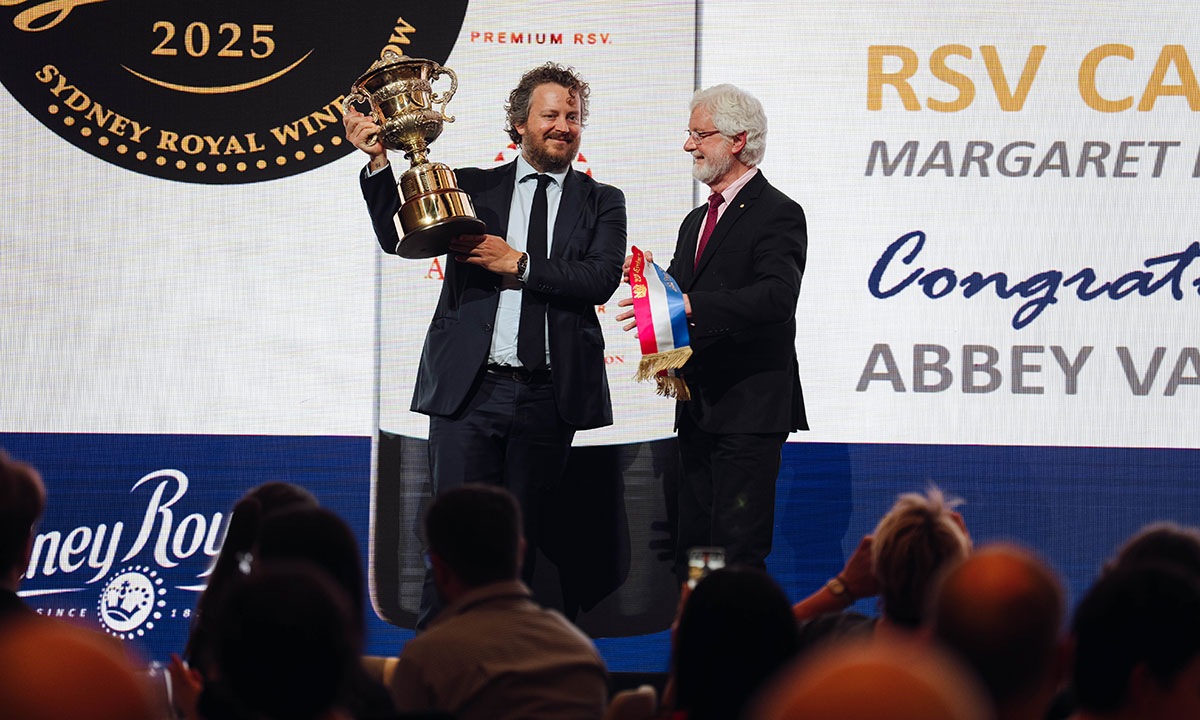
Trophies then sit above the medals. After all class judging is complete, the gold medal winners in each category compete in a final taste-off to determine the best wine in their class. The highest award of all at the Sydney Royal Wine Show is the Tucker Seabrook Perpetual Trophy for Best Wine of Show, which is awarded to one champion wine judged out of the best sparkling, best white and best red finalists. The Sydney Royal Wine Show currently awards perpetual and perennial trophies across every class.
Australia has dozens of wine shows, from large capital city competitions, which each accept wine entries from wine-growing areas right around the country, to regional shows that focus specifically on locally grown grape varieties and wine styles. Each plays a distinct role in the system, and together they form a national network for assessing and improving Australian wine quality.
| Show | Est. | Role in the system |
| Sydney Royal Wine Show | 1826 | Australia's oldest and most prestigious. Capped at 2400 entries, 250+ producers, 58 classes. Sets the national benchmark. 200th anniversary in 2026. |
| Perth Royal Wine Awards | 1843 | Long history, leading West Australian wine competition |
| 1871 | Major capital city show, held at Adelaide Showground. Offers the Philip Laffer Royal Wine Show Bursary | |
| Royal Queensland Wine Show | 1877 | Key agricultural competition in Queensland. The Angelo Puglisi Grand Champion Wine trophy includes $12,000 fellowship |
| 1883 | Capital city competition with history dating to 1883. Well known trophy for best young red wine, the Jimmy Watson Memorial Trophy | |
| Royal Hobart Wine Show | 1973 | The agricultural show dates back to 1822, but wine show only launched in 1973. |
| 1975 | Accepts only gold and silver medal winners from capital city and regional shows. The definitive annual national showcase. Includes the prestigious Prime Ministers Trophy for the National Wine of Show. |
Regional wine shows are also an important part of the broader picture. They assess wines from specific areas against local benchmarks, giving smaller producers independent feedback that is highly relevant to their market. The best of those wines goes on to be judged at the capital city level, and the best of those go forward to the National Wine Show.
The National Wine Show of Australia, which celebrated its 50th anniversary in 2025, draws only from gold and silver medal winners across the capital city and regional shows and presents them as the definitive showcase of the best Australian wine in that year. The top award is the Prime Minister's Trophy for the best wine of show.
The Alternative Varietals wine show, which has been held for over 25 years, also plays an important role in fostering and encouraging lesser-known varietals to be championed.
You can find the listings of all Australian wine shows on the Australian Society of Viticulture and Oenology website.
The judging process at the Sydney Royal Wine Show is designed to be as fair and objective as possible – using the skills of some of the finest, most experienced wine palates in the country. They do the hard work so you can reap the rewards of their work – and with up to 2400 wines tasted each year, they have selected the best of the best. Here’s what happens during judging week.

Wine Committee Member
"Sydney Royal Wine Show has taken a leadership position in many instances, in how wine shows are delivered, but particularly in how we bring together a wonderful group of people to take the industry forward. We talk about bettering the breed, and not just about the wines. It's about developing the whole industry." Sally Evans
Every wine is presented to judges in a numbered, coded glass, so they don’t see the bottle, label, producer name or price point. Judges are given only the vintage year and grape variety. This removes all potential for bias based on brand reputation, winery size, or the cost of the wine. A $20 bottle and a $200 bottle are therefore assessed on the same terms.
At the Sydney Royal Wine Show, there are six judging panels, each consisting of one Panel Chair, two Senior Judges and two Associate Judges, overseen by the overall Chair of Judges. Judges are a mix of esteemed winemakers, viticulturalists, sommeliers, wine educators, retailers, journalists and expert wine tasters from all over Australia. This ensures varying critical perspectives and levels of experience come together to assess the same wines.
Judges score each wine individually and in silence and then discuss them together to reach a consensus. If scores diverge significantly, a wine may be re-tasted. The Panel Chair has the authority to seek advice from the Chair of Judges where consensus cannot be reached.
One of the distinctive features of the Sydney Royal Wine Show is the involvement of an International Judge. Their role is to bring an independent, globally informed perspective to Australian wine. They assess the wines alongside the Australian judging panels and are also invited to award a special prize for the wine that impressed them most. RAS Committee records show that even as early as 1955, the Wine Committee Director requested the President of the Wine Institute of California to send a judge for the competition. A fabulous way for sharing our wine stories with the world!
The practice reflects how seriously the Sydney Royal Wine Show takes its global standing. Australian wine is sold and enjoyed in wine markets across the world, and an international expert ensures that Australian wines are assessed not just against a domestic standard, but also against the expectations of the world's most discerning wine cultures.
Over the years, the International Judge role has attracted respected wine authorities from the United States, Canada, the United Kingdom, Asia and Europe. Many of these judges are highly involved in wine, many with a Masters of Wine qualification. For 2026, the role will be filled by Matthew Jukes, one of the UK's most prominent wine writers and a long-term champion of Australian wine. Matthew has published his 100 Best Australian Wines report for almost two decades and was made Honorary Australian of the Year in the UK in 2012. This recognised his contribution to promoting Australian wine on the world stage.
Recent International Judges at the Sydney Royal Wine Show include:
|
Year |
International Judge |
Country |
|
2026 |
Matthew Jukes |
United Kingdom |
|
2023 |
Clara Rubin |
United Kingdom |
|
2021 |
Ms DJ Kearney |
Canada |
|
2019 |
Mr Roderick Smith MW |
France |
|
2018 |
Ms Fongyee Walker MW |
China |
|
2017 |
Mr Mark Pygott MW |
Taiwan |
|
2016 |
Michelle Bouffard |
Canada |
|
2015 |
Ms Jane Parkinson |
United Kingdom |
|
2014 |
Ms Lisa Perrotti-Brown MW |
Singapore |
|
2013 |
Chuck Hayward |
United States |
|
2012 |
Mr Ned Goodwin MW |
Japan |
|
2011 |
Mr Stephen Brook |
United Kingdom |
|
2010 |
Mr Poh Tiona Ch’ng |
Singapore |
|
2009 |
Mr Barry Burton |
Hong Kong |
|
2008 |
Mr Tom Cannavan |
United Kingdom |
|
2007 |
Mr David Furer |
United Kingdom |
|
2006 |
Mr Matthew Jukes |
United Kingdom |
|
2005 |
Mr Michael Fridjhon |
South Africa |
|
2004 |
Mr Andrew Jefford |
United Kingdom |
|
2003 |
Mr Simon Woods |
United Kingdom |
|
2002 |
Mr Gerald D Boyd |
California |
|
2001 |
Mr Bob Campbell MW |
New Zealand |
|
2000 |
Anthony Hanson |
United Kingdom |
|
1999 |
Mr. Dan Berger – LA Times |
United States |
|
1990 |
N.L. Chroman |
United States |
|
1985 |
Jane MacQuitty |
United Kingdom |
In the Sydney Royal Wine Show, wines are entered across 55 classes grouped by grape variety and style. Within each class, wines are further grouped by geographical region so that a Hunter Valley Semillon is not compared directly against a Clare Valley Riesling. The aim is always to make the comparison as meaningful as possible.
Once all class judging is complete, gold medal winners advance to trophy judging. All judges participate, voting by secret ballot to determine the best wine in each category. The process ends with the award of the Tucker Seabrook Perpetual Trophy for Best Wine of Show, the highest individual honour in the competition.
The quality of a wine medal is only as good as the people who award it. At the Sydney Royal Wine Show, that quality is exceptionally high. The judging panels bring together some of the most experienced and respected wine palates in the country, drawn from every part of the wine world. These people have a passion for wine, for assessing quality and helping to improve the wines being made here in Australia.
The judges are professionals who taste wine for a living, think about it critically, communicate it to others and have spent years or decades developing the consistency and precision required to evaluate wines fairly and accurately. When they assess a wine, they bring a depth of knowledge about variety, region, vintage and style that makes them absolute experts in the field. So you don’t need to know the technical details, knowing that the medal on a bottle is a testament to a rigorous process to give you guidance on wines to enjoy.
A genuinely diverse judging panel
It’s fair to say that the judging panels have grown in size since the early days of judging, mirroring the growth in entries. The judging panel at the Sydney Royal is deliberately built to include many different perspectives on wine. Winemakers bring a technical understanding of how wine is made. Sommeliers bring the perspective of someone who matches and serves wine for demanding guests every day. Wine writers and journalists bring the critical, communicative viewpoint of someone who must explain wine to a broad audience. Retailers and educators round out the picture with commercial and teaching experience.
In 2025, the Sydney Royal Wine Show judging panel included winemakers such as Melanie Chester of Giant Steps in the Yarra Valley and Gwyn Olsen of Henschke in the Eden Valley, two of Australia's most celebrated producers. They were joined by sommeliers, including Solotel’s Group Beverage Manager Annette Lacey MW, who oversees the wine programs across some of Sydney's most respected restaurants and is one of only a handful of Australians to hold the Master of Wine qualification. Wine media was represented by Cassandra Charlick, an award-winning wine journalist who writes for Decanter Magazine and was named the 2024 International Wine and Spirit Competition Emerging Wine Communicator of the Year.
The show system has often benefited from some of the best palates and brightest minds in wine coming together to identify wines that are exceptional and benchmark products with peers.
Becoming a Sydney Royal Wine Show judge is a career-long journey. Most start as stewards, learning the mechanics of how a competition runs. From there, they progress to Associate Judge roles where they score wines alongside experienced Senior Judges. Full judging appointments come with time, demonstrated consistency and the ability to articulate quality clearly to the rest of the panel.
The RAS actively invests in developing the next generation of judges. Many of Australia’s finest wine judges have started their judging career as an Associate Judges, and then progress to Panel Chairs or even Chair of Judges. Names like Ian Mackenzie, Vanya Cullen, Kerri Thomson, Adam Wadewitz, Melissa Moore, Kate Goodman, Emma Wood, Toni Paterson all started as Associate Judges before going on to more senior positions.
Advancing the talent of wine judges remains at the heart of Sydney Royals’ mission. The Peter Doyle Trophy is selected by the Chair of Judges and is awarded to the Associate judge who not only performs well during judging and related exercises, but who also displays a great attitude throughout the Show. It is presented in honour of Peter Doyle, legendary Sydney seafood restaurateur and long-term supporter of the Sydney Royal Wine Show education program during the 1980s and 1990s. In recent years, the Peter Doyle Trophy has been awarded to Hugh Spinaze (2025), Michael Latham (2004), Phillip Le Messurier (2023), Skye Salter (2022), Alex Kirkwood (2019) and Brendan Carr (2018).
Each year, the Sydney Royal Wine Show Study Scholarship supports a promising wine industry student, and the Professional Development Scholarship gives a young wine professional a fully funded place at the Australian Wine Research Institute's Advanced Wine Assessment Course in Adelaide. Several of today's judges first connected with the Sydney Royal Wine Show through these programs. Cassandra Charlick, for example, was the 2024 recipient of the scholarship before judging at the 2025 show.
The Chair of Judges is the most senior role at the Sydney Royal Wine Show. They are responsible for appointing the judging panels, ensuring a consistent standard of assessment across all 55 classes and overseeing the final trophy judging to confirm the best wine in each category.
The Chair sets the tone for the entire competition. Their job is to ensure that every judge, in every panel, is assessing wines against the same standard, and that the results carry the authority and consistency that is associated with the Sydney Royal Wine Show.
Current Chair of Judges Mike de Iuliis, winemaker at De Iuliis Wines https://dewine.com.au in the Hunter Valley, described his perspective on the show when appointed in 2025:
De Iuliis also emphasised the show's international reach, noting that the Sydney Royal Wine Show has a rich legacy of promoting Australian wines on the world stage. He encouraged all winemakers, regardless of size or scale, to consider entering, describing it as an excellent opportunity to showcase products, gain valuable insights, and join the ranks of Australia's best winemakers.
The list of Chairs of Judges reflects some of the most respected names in Australian wine, starting with George Fairbrother. Committee minutes from 1965 show that correspondence from the Wine and Brandy Producers Association of NSW suggested that consideration be given to appointing two panels of five judges, plus a Chairman, for the wine section of the Royal Easter Show. Mr Fairbrother was invited to officiate at the 1967 Royal Easter Show.
It’s fair to say that these chair of judges have all played a pivotal role in ensuring the relevance of the show, keeping up with stylistic changes and ensuring that the next generation are brought into system.
|
Period |
Chair of Judges |
Wine Connection |
|
2025–2027 |
Michael (Mike) de Iuliis |
De Iuliis Wines, Hunter Valley |
|
2022–2024 |
Sarah Crowe |
Yarra Yering, Yarra Valley |
|
2018–2021 |
PJ Charteris (no show held in 2020 due to covid) |
Charteris Wines, Hunter Valley |
|
2015–2017 |
Samantha Connew |
Stargazer Wines, Tasmania |
|
2009–2014 |
Iain Riggs AM |
Brokenwood Wines, Hunter Valley |
|
2006–2008 |
James Halliday AM |
|
|
2001–2005 |
Brian Croser AO |
Formerly Petaluma, now owns Tapanappa |
|
1978–2000 |
Len Evans AO OBE |
|
|
1967- 1977 |
George Fairbrother |
|
Source: Royal Agricultural Society of NSW records
No one has shaped the modern Sydney Royal Wine Show more than Len Evans, who served as Chair of Judges for more than 25 years, from 1978 to 2000 and was a judge prior to this, starting out as an Associate at the Sydney Royal Wine Show in 1963. In this time, the show grew from a respected industry event into a nationally and internationally recognised benchmark for Australian wine quality.
During his tenure, Len oversaw many changes in the show, evolving the judging process as styles shifted and consumers gained greater access to table wines — always championing quality above all else. In an oral history interview in 1996, he recalled how when he began judging there were only two panels. By bringing in names like James Halliday, Ian McKenzie, Vanya Cullen, John Duval and Brian Croser, the assessment of wines became increasingly rigorous. It was a period that saw the show move with the times — from fortified wines and styles like claret and hock, to the varietal revolution that Australia helped drive, first in whites and then in reds.
Len Evans passed away in August 2006, aged 75. He is honoured through the Len Evans Memorial Perpetual Trophy for Best Single Vineyard Wine, which is awarded at the show each year. His daughter Sally Evans continues the family connection to the RAS, serving as a councillor of the Royal Agricultural Society of NSW. Sally started as an Associate Judge in 2000 (Len’s last year as Chief Judge), also playing a vital role as Chair of the Wine Committee.
In 2001, Len Evans also founded the famous Len Evans Tutorial, an independent program dedicated to training the next generation of wine professionals. It is a distinct organisation from the Sydney Royal Wine Show, although the RAS has been a proud sponsor of the Tutorial since 2008, reflecting a shared commitment to the future of Australian wine expertise.
Stewards are the people who make the judging day work. Up to 40 stewards work together to unpack and code the wine entries, set up the judging room, pour each wine into numbered glasses and deliver them to the judging panel. They keep meticulous records and ensure that no identifying information about any wine ever reaches a judge before scoring is complete.
It sounds straightforward, but the role requires precision and absolute confidentiality. A single error in coding or pouring can compromise the integrity of an entire class. For many, stewarding is also the first step toward judging. The required discipline is a solid foundation for becoming a great wine judge.
The people behind the scenes: The Steward in Chief
At the Sydney Royal Wine Show, the steward operation is led by the Steward-in-Chief, who often is the Chair of the Wine Committee, combining both responsibilities. The role of Steward-in-Chief has been held by several respected figures over the years, including Lyndey Milan OAM, and Sally Evans. Both have served as Steward-in-Chief and are currently councillors of the RAS NSW.
The current Steward-in-Chief and Chair of the Wine Committee is Angus Barnes, who is also a councillor of the RAS and General Manager of Bunnamagoo Wines in Mudgee. Angus brings to the role a great understanding of the wine industry, honed through extensive commercial roles consulting along with domestic and international positions at Pernod Ricard Winemakers. He has also served in exective roles at NSW Wine Industry Association and the Executive Chair of Wine Communicators of Australia. In 2025, Angus was named the inaugural recipient of the Real Review’s Len Evans Prize for outstanding service to the Australian Wine Industry.
High-profile figures have held other key roles, such as the late David Clarke of Macquarie Bank, who was Chairman of the Wine Committee for more than 10 years. Others, such as Graham Thorp, who served as Chair from 1984 to 1990, have also left enduring legacies. Thorp’s deep commitment to wine education and judging standards are honoured by the scholarship program now run by the RAS.
The Chief Steward
For the last few years, the Chief Steward for Sydney Royal Wine Show has been William Wilson. A Certified Sommelier and Food and Beverage Manager at the International Convention Centre Sydney, Wilson has been instrumental in curating ICC Sydney's 100% NSW wine list, and he has been awarded Best NSW Wine List by a Caterer or in a Functions Venue at the NSW Sommelier's Wine List Awards four times. Since ICC Sydney opened in 2016, Wilson has helped facilitate the distribution of over 400,000 bottles of local wine and directed over $77 million towards NSW food and wine producers. He is also a trained judge, having been an invited judge at the Australia and New Zealand Boutique Wine Awards. In 2023, William was awarded the Champions of the RAS Award, one of the Royal Agricultural Society of NSW’s most prestigious awards, recognising individuals who have exhibited an outstanding dedication to not only the Show, but the wider agricultural industry.
In 2026, Marcus Patz will take over the reins as Chief Steward. Marcus is a former scholarship recipient, a steward for many years and works as a Fine Wine Merchant at Endeavour Group.
The standard of stewarding directly affects the integrity of the whole competition. When every glass is correctly coded, every pour is precise and every exhibit reaches the panel in identical condition, the results can be trusted. That is what makes a Sydney Royal medal meaningful.
Looking to the Future
Few wine competitions anywhere in the world can claim the history, rigour or influence of the Sydney Royal Wine Show. That it has remained genuinely relevant to Australian wine, shaping how it is made, assessed and understood, is a reflection of the people who have given their time to it. The judges, stewards, scholars and committee members who make it work each year are part of a chain that stretches back to 1826.
In 2026, that chain is worth celebrating. For any producer considering whether to enter, it is worth being part of.
A wine show is a competition where independent expert judges taste and score wines without knowing whose they are, what they cost, or where they come from. Medals are awarded to any wine that reaches the required quality threshold on a 100-point scale. The result is a genuinely independent mark of quality that you can trust on a bottle.
Wines are presented to judges in coded glasses with no labels or identifying information. Judges score each wine individually on a 100-point scale, then discuss and reach a consensus. Gold medals go to wines scoring 95 and above, Silver for 90 to 94, and Bronze for 85 to 89. Gold medal winners from each class then compete in a final taste-off to determine class and overall trophies.
A gold medal from the Sydney Royal Wine Show means that a panel of expert judges, tasting the wine blind, scored 95 points or more out of 100. Very few wines in any class receive gold. It is one of the most meaningful quality signals available to Australian wine consumers.
In the 2025 Show, 103 gold medals (6.65% of entries) were awarded from 1551 entries. There were 302 silver and 627 bronze.
No. Medals are only awarded to wines that reach the required score threshold. There is no guarantee that any entered wine will receive a medal, and there is no fixed number of medals available. A wine that does not reach 85 points does not receive an award.
Judges at the Sydney Royal Wine Show come from across the wine industry: winemakers, sommeliers, viticulturalists, wine educators, retailers and journalists from around Australia. An International Judge is also invited each year. In 2026, that role will be filled by Matthew Jukes, one of the UK's most prominent wine writers and a passionate advocate for Australian wine on the world stage.
The Sydney Royal Wine Show is the oldest and most prestigious wine competition in Australia. Established in 1826 by the Royal Agricultural Society of NSW, it predates every other wine show in the country by more than 60 years and has been judging Australian wine continuously for nearly 200 years. The show attracts a maximum of 2400 entries each year from over 250 producers across Australia, and its results set the national benchmark. To win at the Sydney Royal is to be recognised by the show that, quite literally, defines what quality Australian wine means.
Results from the Sydney Royal Wine Show are published online each year following the Trophy Winners Luncheon in August. You can find results and medal-winning producers at rasnsw.com.au. All medal-winning wines can also be tasted in person at the Grape, Grain & Graze Festival, held each September at Sydney Showground.
The 2026 Sydney Royal Wine Show marks the 200th anniversary of the competition. Producer entries open on 22 April, 2026. The show will be judged in July 2026 at Sydney Showground, Sydney Olympic Park, with results announced in August 2026.
Whether you're a winemaker, a wine lover or simply someone who wants to taste the best Australian wines, get involved in the 200th Sydney Royal Wine Show.
Producer entries open 22 April 2026 | Close 20 May 2026